Features

The programme, the workout, and what changes next.

Cairn: Form does three things: it compiles a programme you can actually train, it records what you did, and it decides what resistance to offer next. This page is what each of those means in practice.

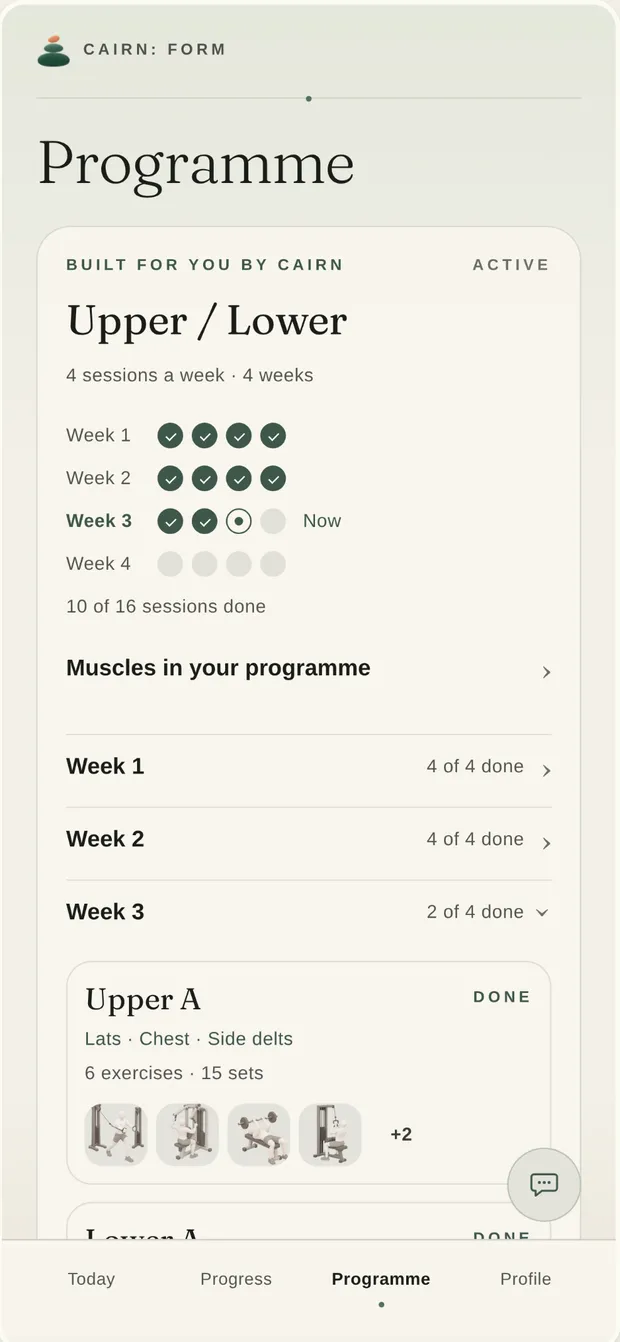
The Programme screen in Cairn: Form, showing an Upper / Lower programme of four sessions a week across four weeks, with per-week completion and the sessions in week three.

Programme generation

Built from your constraints, not a template.

You tell Cairn what you have and what you cannot do. It resolves a four-week block against a curated exercise catalogue, by the same rules every time.

  1. 1

    What you train with

    Your gym or your garage: barbells, dumbbells, machines, cables, bands, a bench or nothing at all. Cairn only prescribes work you can actually perform with what you listed.

  2. 2

    What your week looks like

    How many days you can train, and how long a session can run. Session length is a ceiling the programme is built to respect, not a target it drifts past.

  3. 3

    What you want, and what you must avoid

    A goal, muscles you want prioritised, and any movement or exercise to exclude. A recorded movement limitation makes Cairn avoid or substitute that work. It is a programming input — not a diagnosis, and not medical advice.

  4. 4

    A block you can see before you start

    Four weeks, session by session, with every exercise, its sets, its target repetition range, its effort and its rest. You review the programme and activate it; nothing starts behind your back.

No model writes your programme

Programme generation is a deterministic resolver over a curated catalogue. It makes no network calls and no inference calls. The same answers produce the same programme.

The workout

Everything you need for the next set. Nothing else.

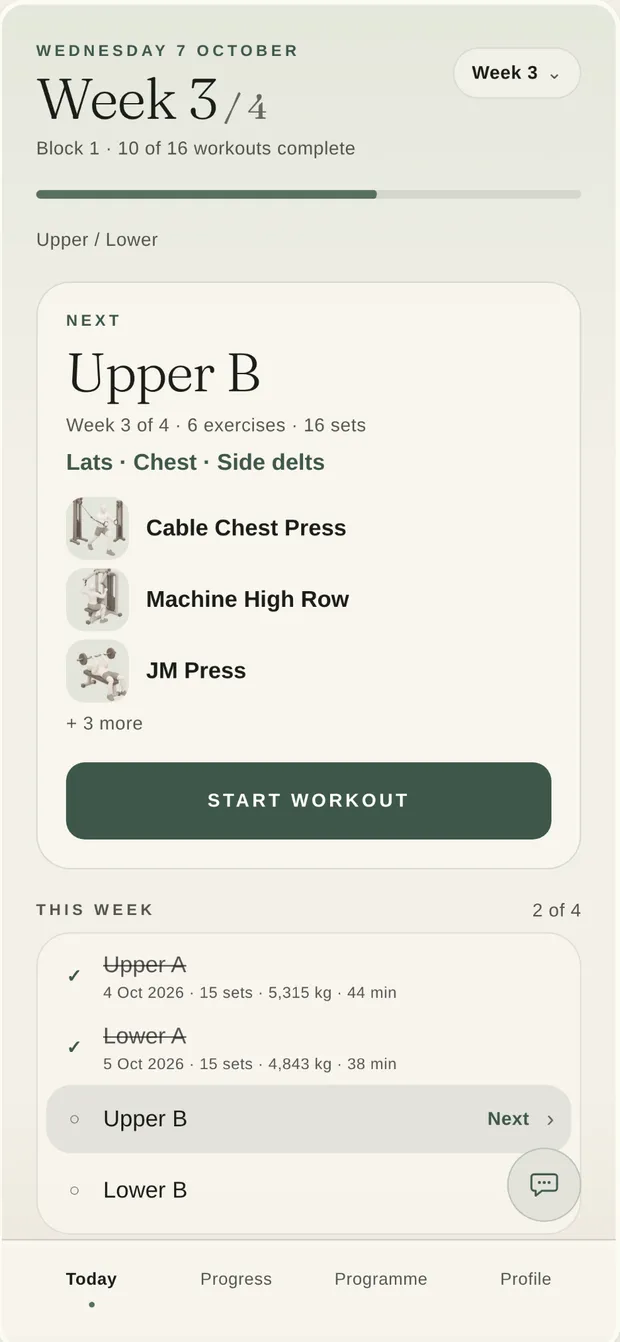
Open the session and the work is laid out: the exercises, how many sets remain, and what you lifted last time for this exact slot. Log load, repetitions and effort as you go.

A rest timer that keeps time while you put your phone down. Compatible substitutions when the rack is taken. Press and hold to reorder today's session when the gym makes you. A workout in progress survives the app being closed — it is still there when you come back.

Workout questions in support
The Today screen, showing the next session with its exercises and a Start workout button, above this week's completed and remaining sessions.

Individual resistance progression

The one decision you cannot make for yourself every session.

What weight should you use today? Cairn answers it from the sets you logged against the target repetition range, with a deterministic engine that runs on your phone.

It never invents a weight

Until Cairn has seen you lift something, that exercise has no load. It will tell you that you owned the repetition range and still decline to guess a number. Starting weight is settled over your first exposures, from what you actually do — including an opening suggestion and a short ramp when an exercise is new to you.

The range is the prescription; load is the variable

An 8–12 stays 8–12. Cairn moves the weight to keep you working in the range your programme asked for, rather than quietly changing the range because the weight got easier.

One bad session is not a signal

A shortfall counts only when the repetitions were missed and the effort was genuinely hard. Choosing to stop early at an easy effort produces nothing. A session with no performed sets advances neither a good streak nor a bad one — missing training is an absence of evidence, never evidence of failure.

Every change states its reason

Decisions come from a closed list of reasons, not free text a screen can invent. A hold says which kind of hold it is: no clear call either way; the next weight in your gym is a long jump; the effort reading disagreed with the repetitions; too much of the block was missed to read a stall.

What progression is not

Cairn does not estimate or test a one-rep max, does not measure fatigue, does not schedule deloads or periodise your training, and does not rotate your exercises for variety. Where a muscle has stalled across two blocks, it may move that muscle's set count by one — and it tells you when it does.

Training block reviews

Four weeks are read at once.

A block closes after four weeks. Cairn reads what happened across all of it — per exercise and per muscle — and that review is what builds the next block: which loads carried forward, which exercise has been flat long enough to be worth a conversation, whether a muscle's volume should move.

Reviewing at the boundary is deliberate. It means one hard week does not redirect four months of training, and it means the evidence behind a change is a block's worth, not a day's.

If your training declined across the block and you tell Cairn that recovery was difficult, it will recommend a lighter week. It recommends; you decide. Your stored programme is not altered by that recommendation.

What the block review needs
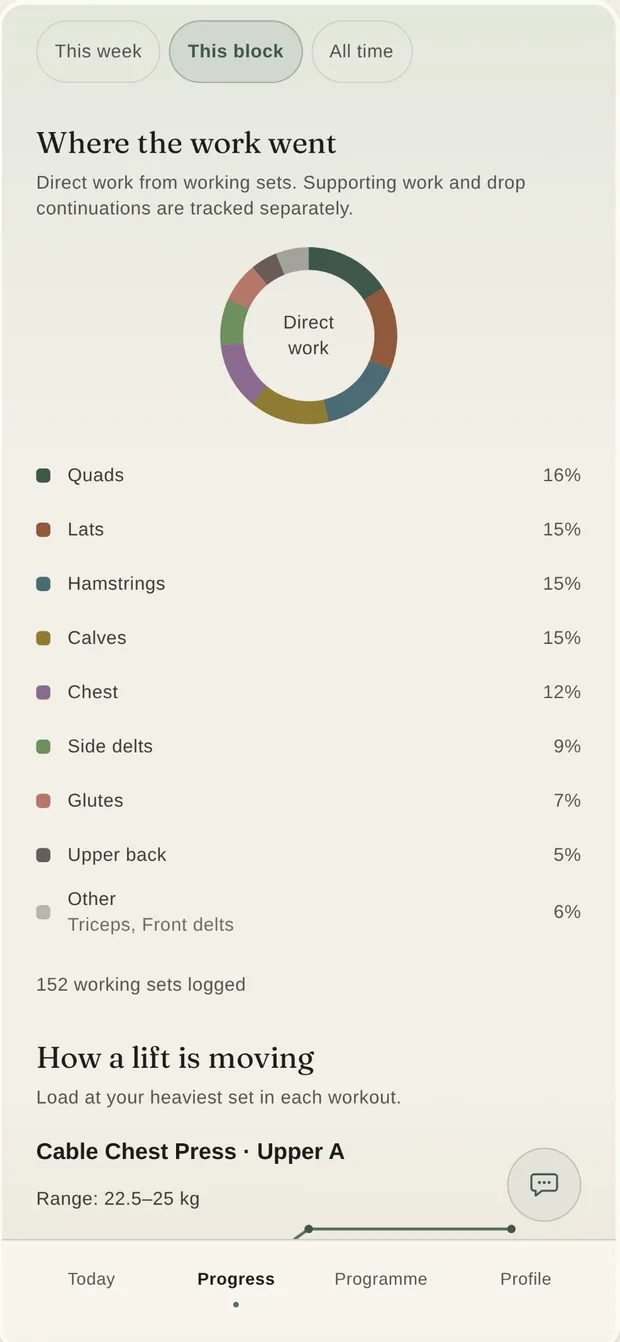
The Progress screen, showing a doughnut chart of direct work by muscle group with percentages, the count of working sets logged, and a chart of how one lift has moved.

Progress tracking

The record, gathered into a few clear views.

Where the work went

Direct work by muscle group, for this week, this block or all time, with the number of working sets behind it. Supporting work and drop continuations are counted separately rather than quietly inflating the total.

How a lift is moving

Load at your heaviest set in each workout, exercise by exercise, with the range you have been working in.

What you completed

Sessions done against sessions planned, week by week and block by block — the same adherence Cairn uses to decide how strong an inference its review may draw.

Rowan

An in-app coach that explains, and cannot overrule.

Rowan is a conversational AI coach. It reads your training record and answers from it — and it is structurally unable to write a prescription.

What it does

Explains what your programme is doing and why, answers questions about the session in front of you and about your own logged training, and can put together a one-off session when you ask for one.

What it cannot do

Change your programme, alter a prescription, or decide your next weight. Those belong to the progression engine and to you. Rowan is an AI and can make mistakes; it is not medical advice, and the app says so every time you open it.

Nothing is sent until you agree

Your first message asks for permission first. When you do send one, your message and a summary of your training go to our server and on to the model provider that writes the reply. Nothing is stored on our server. The privacy policy sets out exactly what travels and where it goes.

The evidence behind the rules

Evidence-informed, and specific about what that means.

Cairn's programming draws on published training evidence for the direction of its rules: that effort estimates carry roughly a repetition of error, that load steps and effort targets should move the way they do. That is what the citations in the engine support.

The exact numbers — the weekly set envelope, the repetition and rest bands, how many confirmations a progression needs, how far a lighter week drops the work — are Cairn's own product choices. Each one is recorded in the app's policy as a Cairn heuristic, with a note saying what it is not: not a universal minimum, not an evidence-backed optimum, not a measured threshold.

We would rather say that plainly than dress a product decision up as science. Evidence describes what tends to happen across groups of people. It is not a prediction about you, and nothing in Cairn guarantees a particular result in muscle, strength, body composition or health.

Training information, not medical advice

Cairn produces general training information. It is not a diagnosis, a treatment plan or a substitute for a qualified professional. If you have a condition or injury, are pregnant, or are recovering from illness or surgery, get advice before starting a programme. The Terms of use set this out in full.

See it with your own training.

Building a programme and logging your workouts is free.